

DECORTÉ's New Concealer Palette Is More Than Concealer: A Guide to Tone & Flat Perfecting Palette
DECORTÉ's New Concealer Palette Is More Than Concealer
A dark circle is not the same problem as a brown spot.
Redness around the nose is not the same problem as visible pores.
And a shadow caused by facial structure cannot always be fixed simply by applying a lighter concealer.
That sounds obvious, yet we often expect one beige concealer to solve all of them.
DECORTÉ's new Tone & Flat Perfecting Palette, launching in Japan on August 21, 2026, takes a more systematic approach.

Instead of treating concealer as a single covering product, the four-pan palette assigns different textures and colours to different kinds of visible "noise": pigmentation, redness, shadows, uneven tone, pores and surface irregularities.
There are now five palettes — 00, 01, 02, 03 and 101 for 5g. The four beige palettes handle conventional concealing and highlighting, while the completely new 101 approaches complexion correction through colour and light.
The easiest way to understand the new DECORTÉ concealer isn't pan by pan.
It's problem by problem.
First, What Changed From the Original Tone Perfecting Palette?
This is an important question because the previous Tone Perfecting Palette was already one of DECORTÉ's established base-makeup products.
Japanese users have praised the original for years for its ability to cover dark circles and spots without looking excessively heavy. Its @cosme listing currently sits around 5.4/7 from more than 4,300 reviews. Recent reviews still repeatedly mention thin coverage, moisture, dark-circle correction and the ability to mix shades.
So DECORTÉ hasn't simply replaced an unsuccessful product.
It has expanded what the palette is supposed to correct.
|
Previous Tone Perfecting Palette
|
New Tone & Flat Perfecting Palette
|
|---|---|
| 3 palettes | 5 palettes |
| Primarily tone correction | Tone + texture + dimensional correction |
| Beige-based palettes | 4 beige palettes + 1 colour-control palette |
| Natural coverage | Thinner-film high coverage |
| Highlight + concealer | Highlight + concealer + colour correction + pore/texture correction |
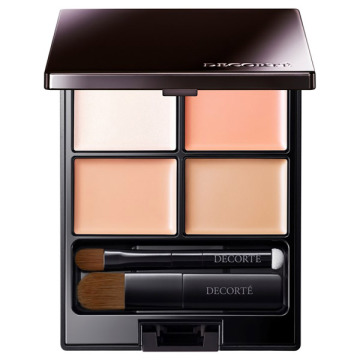
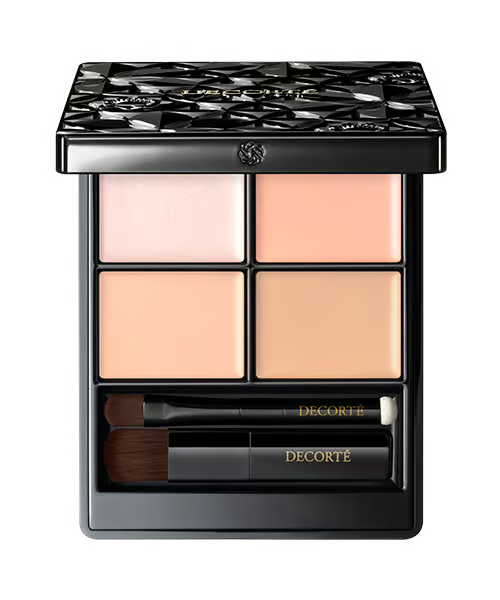
MAQUIA and 美的 both specifically note the thinner finish, smoother texture and expanded shade selection, while VOCE highlights the pursuit of a more skin-like transparent result.
The name change from Tone Perfecting to Tone & Flat Perfecting therefore makes sense.
The new palette isn't only correcting colour.
It's also trying to make the surface of the complexion look more even.
Problem 1: Blue or Brown Dark Circles
This is probably the reason many people discovered the original palette.
DECORTÉ's beige palettes retain a dedicated reddish concealing colour for the eye area.
The logic is colour correction rather than simply brightness: the warmer, blood-tone colour helps neutralise bluish shadows and dullness before the surrounding beige shades are used to blend the correction back into the complexion.
How to use it
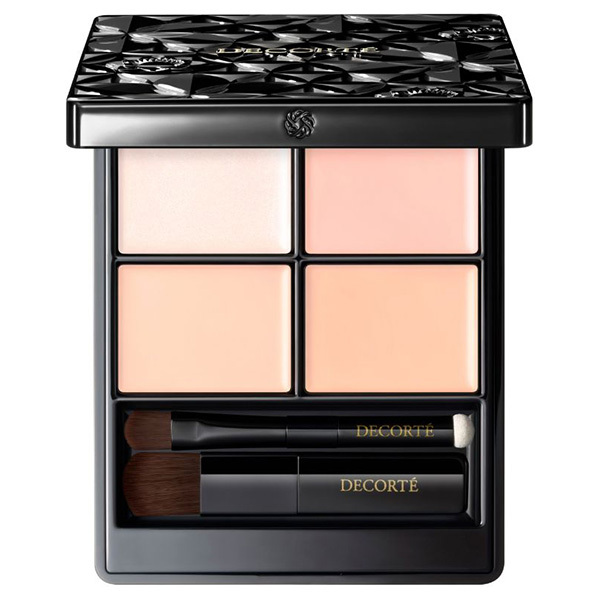
Use the upper-right concealer shade over the discoloured area rather than covering the entire lower eye.
Then adjust the edges with one of the beige shades.
The upper-left highlighting shade can be used afterwards where you actually want light.
This distinction matters.
Colour corrects the dark circle; light corrects the shadow.
Those aren't always the same thing.
Problem 2: A Hollow Under the Eyes
Sometimes you apply concealer and the "dark circle" remains.
That's because part of what you're seeing may be structural shadow rather than pigmentation.
Adding increasingly opaque beige can then make the under-eye look heavier without removing the shadow.
This is where the palette's upper-left highlight shade becomes useful.
DECORTÉ specifically recommends it around the eyes as well as the nose bridge and cheekbones. Its fine pearl creates subtle light rather than conventional opaque coverage.
Think of the two upper pans as solving different under-eye problems:
Upper right → colour
Upper left → light
For many people, using both selectively will look more natural than building one thick layer of concealer.
Problem 3: Spots, Acne Marks and Small Areas of Redness
These require the opposite technique.
You don't necessarily want luminosity.
You want precision.
The two lower beige shades provide different depths so they can be used individually or mixed until the colour disappears into the surrounding skin.
DECORTÉ recommends them for:
- pigmentation
- acne marks
- localised redness
- other small areas requiring concentrated coverage
The advantage of having two beige depths in one palette is that your concealer doesn't need to be exactly one fixed shade throughout the year—or even across the entire face.
This is one reason palette concealers remain useful even when liquid concealers are easier to apply.
You can create the shade instead of searching for it.
Problem 4: Your Concealer Covers the Spot but Looks Like Concealer
This is where the biggest formula change becomes relevant.
DECORTÉ has introduced what it calls Thin-Film High-Cover Technology (薄膜ハイカバーテクノロジー).
The new Transparency Cover Powder disperses very fine covering particles densely and evenly within a thin film. According to DECORTÉ, conventional larger covering particles can distribute unevenly and create gaps or thickness; the finer dispersion is intended to form a smoother, more uniform layer while retaining high coverage.
There's also a new Light-Transmitting Powder designed to transmit and reflect light in a way DECORTÉ compares with translucent stratum corneum, creating a foggy optical effect that blurs visual skin noise instead of relying solely on opacity.
That's an important distinction.
Traditional concealing logic is:
more pigment → less visible imperfection.
The new DECORTÉ approach adds another mechanism:
controlled light → less visible contrast.
This is how the brand is trying to achieve the seemingly contradictory combination of “隠す” and “透ける” — conceal while retaining transparency.
Problem 5: Visible Pores and Uneven Texture
Now we get to the most interesting addition.
101 Color Control Palette

101 isn't simply another shade for a different skin tone.
It's a different kind of palette.
Instead of four variations around beige concealing, DECORTÉ describes it as a colour-control palette that manipulates colour and light, designed to address pores, dullness, redness and dimensionality.
Its four functions are:
Texture Correction
For the T-zone, cheeks and other areas where pores or uneven texture are noticeable.
The aim is to visually smooth irregularities and create a flatter, more uniform-looking surface.
Redness Correction
For acne marks and redness around the nose or cheeks.
Instead of covering redness with increasingly thick beige, the corrective colour neutralises the unwanted tone first.
Healthy Colour
For dullness around the eyes, mouth and other areas that make the complexion look tired.
The reddish brightening colour restores the impression of healthy circulation and can also be used where bluish tones are visible.
Transparency Highlight
For cheekbones, the C-zone, nose bridge and chin.
Fine pearl adds controlled brightness and dimensionality rather than simply covering something.
So 101 isn't really the "fifth concealer shade."
It's closer to a miniature complexion-correction kit.
00, 01, 02 or 03: Which Beige Palette Should You Choose?
The new range expands the conventional beige selection from three options to four, with a new lighter tone added.
MAQUIA specifically notes that the beige family now covers a broader range of skin tones.
A practical way to approach them is:
| Palette | Start Here If |
|---|---|
|
00
|
You have a very fair/light complexion |
|
01
|
You have a light complexion |
|
02
|
You sit around a medium skin tone |
|
03
|
You need greater beige depth |
|
101
|
Your main concerns are redness, dullness, pores or uneven texture rather than simply spots |


The exact match should still be judged against your complexion because the lower concealer shades are designed to blend into—or be mixed to recreate—your individual skin colour.
Interestingly, one early Japanese @cosme user who previously owned 01 and 02 reserved the new 00 specifically because of its brighter tone, noting its usefulness for adding brightness around the under-eye area.
Beige Palette or 101? This Is the More Important Decision

Instead of obsessing over shade numbers first, decide which type of correction you need.
Choose 00–03 if your main concerns are:
- dark circles
- pigmentation
- acne marks
- isolated redness
- small imperfections
- precise spot concealing
Choose 101 if your main concerns are:
- visible pores
- uneven texture
- broader facial redness
- dullness around the eyes or mouth
- overall tone correction
- adding strategic brightness
And yes, there is a case for owning both.
The beige palette handles local imperfections.
101 handles the surrounding complexion.
That combination could potentially reduce how much foundation you need.
Could This Replace Foundation?
For some makeup styles, partially.
DECORTÉ itself shows a routine consisting of:
primer → Tone & Flat Perfecting Palette → face powder
without foundation, specifically describing the result as a transparent, bare-skin-like finish.
That's actually one of the more interesting uses for this product.
Instead of applying foundation everywhere and then concealing imperfections, reverse the logic:
correct only what needs correcting,
leave good skin visible,
then unify the finish with powder.
For people who prefer lighter Japanese base makeup, the palette becomes less of an emergency spot concealer and more of a foundation-reduction tool.
Where Does It Go in Your Makeup Routine?
DECORTÉ allows the palette before or after foundation, but the exact order depends on foundation type.
With Liquid or Cushion Foundation
Primer → Liquid Foundation → Concealer Palette → Face Powder
This keeps the foundation from disturbing the concentrated correction.
With Powder Foundation
Primer → Concealer Palette → Powder Foundation
Cream concealer generally sits more cleanly underneath powder than over it.
Without Foundation
Primer → Concealer Palette → Face Powder
This is the most interesting option if your goal is skin that looks less made-up rather than more perfected.
MAQUIA's recent long-wear base-makeup feature also recommends concealer after liquid foundation and suggests applying with a brush before lightly pressing with a sponge.
What About Dry Under-Eyes?
This was already one of the reasons people liked the original palette.
Recent @cosme reviews of the previous version repeatedly mention moisture, thin-film coverage and suitability around dark circles, including positive feedback from users with dry skin.
DECORTÉ has specifically addressed that issue again in the reformulation.
The new formula increases oils that melt with body temperature, helping the cream spread more easily and adhere to uneven skin without becoming powdery when layered. It also contains a substantial group of moisturizing ingredients including jasmine extract, damask rose extract, hydrolysed hyaluronic acid, murumuru butter and olive squalane.
The official claim is not simply "moisturising."
It's aimed at two classic concealer failures:
powderiness and cracking.
That is much more relevant around the eyes than simply adding another skincare ingredient to the label.
The New Palette vs the Old Tone Perfecting Palette
If you already own the original, you don't necessarily need to replace it immediately.
The old palette remains a very capable concealer.
But the upgrade becomes meaningful in three situations.
You found the old formula slightly too visible when layered.
The new version specifically targets thinner, smoother high coverage.
You couldn't find the right depth.
The beige family expands to four palettes, including the new lighter 00.
You want to correct pores, redness and dullness rather than just cover spots.
101 is completely new territory for this product family.
In other words, the most significant upgrade isn't necessarily "better coverage."
It's more types of correction.
DECORTÉ Tone & Flat Perfecting Palette at a Glance

| Product | DECORTÉ Tone & Flat Perfecting Palette |
| Japan Release | August 21, 2026 |
| Price | ¥7,722 |
| Size | 5g |
| Variations | 00 / 01 / 02 / 03 / 101 |
| 00–03 | Beige Tone Palettes |
| 101 | Color Control Palette |
| Finish | Thin-film, high coverage with transparency |
| Key Upgrade | Tone + texture correction |
| Best Known Uses | Dark circles, spots, redness, pores, uneven tone, highlighting |
DECORTÉ positions the reformulated palette as going beyond conventional correction to create a clearer-looking complexion while maintaining high coverage.
Frequently Asked Questions
Is DECORTÉ Tone & Flat Perfecting Palette replacing Tone Perfecting Palette?
The new Tone & Flat Perfecting Palette is the evolved version of the existing Tone Perfecting Palette, with a smoother formula, thinner high-cover film and expanded five-palette range. Japanese beauty media explicitly describe the product as a renewal/evolution of the popular original.
What's the difference between 00, 01, 02 and 03?
They are four beige-tone palettes designed to accommodate different complexion depths. Each contains four functional shades for highlighting, dark-circle correction and concentrated beige concealing.
What is DECORTÉ 101 used for?
101 is the new Color Control Palette. It is designed for pores and uneven texture, redness, dullness/healthy colour correction and highlighting, rather than functioning as another conventional beige concealer shade.
Which shade should I use for dark circles?
In the beige palettes, DECORTÉ recommends the reddish upper-right concealer for dark circles and dullness. The surrounding beige shades can then be used to blend or customise the correction.
Can I use it without foundation?
Yes. DECORTÉ specifically shows the palette used after primer and before face powder as a foundation-free routine for a more transparent, natural-looking complexion.
Is the new formula suitable for dry skin?
The formula includes multiple moisturising ingredients and increased body-temperature-melting oils designed to maintain a moist texture and resist powderiness and cracking. Individual results will still vary by skin type.
The Useful Way to Think About Concealer in 2026
The old question was simple:
"What shade of concealer matches my skin?"
DECORTÉ's new palette suggests a better set of questions.
Is the thing you're seeing actually colour?
Is it a shadow?
Is it redness?
Is it a pore?
Is the skin uneven?
Or does that area simply need more light?
Once those problems are separated, piling beige pigment over all of them starts to feel surprisingly crude.
That's where Tone & Flat Perfecting Palette becomes more interesting than an ordinary product renewal.
00–03 still do what a good concealer palette should do: correct dark circles, cover spots and let you mix a believable skin tone.
But 101 changes the scope of the product, bringing pores, redness, dullness and dimensional highlighting into the same correction system.
The goal isn't necessarily to conceal more.
It's to identify what actually needs concealing—and what would look better corrected with colour, texture or light instead.
For a product category built around hiding things, that's a much more modern place to start.