

THREE Balancing Flow: When Essential Oils Become Skincare Actives
THREE has never had to convince anyone that essential oils belong in its skincare.
They are part of the brand's identity—the scent you notice as soon as a product reaches the hands, and one of the reasons THREE skincare feels recognisably different from conventional Japanese department-store beauty.
Its new Balancing Flow collection, launched in Japan on September 4, 2026, makes a more technical argument.

THREE is no longer talking about essential oils primarily as fragrance.
It is using two of its original Japanese essential oils as skin-conditioning ingredients, then building two different skincare systems around them.
The result is not one new Balancing routine.
It is two:
Intensive — for dryness, loss of firmness, dullness and age-related changes.
Conditioning — for the less straightforward combination of dryness, oiliness, visible pores, roughness and uneven texture.
And the difference between them goes considerably deeper than texture.
THREE Has Been Studying What Essential Oils Do to Skin
This is the part of Balancing Flow that deserves more attention than its botanical ingredient list.
THREE says an essential oil can contain roughly 100–400 constituent compounds. Through its research, the brand has been examining its original domestically produced essential oils not only for their aromatic qualities but for their skin-conditioning potential.
Two oils became central to Balancing Flow.
For Intensive, THREE uses its original rosemary essential oil produced in Minamiaso, Kumamoto, focusing on its role in moisture and the appearance of firmness.

For Conditioning, it uses its original peppermint essential oil from the same region, with the formulation designed around the competing problems of dryness and excess sebum.

That's a useful shift in how to read THREE skincare.
The scent is still there.
But in Balancing Flow, the oil responsible for the scent also helps determine which skin condition the formula is built around.
Intensive: When Dryness Starts to Affect Firmness
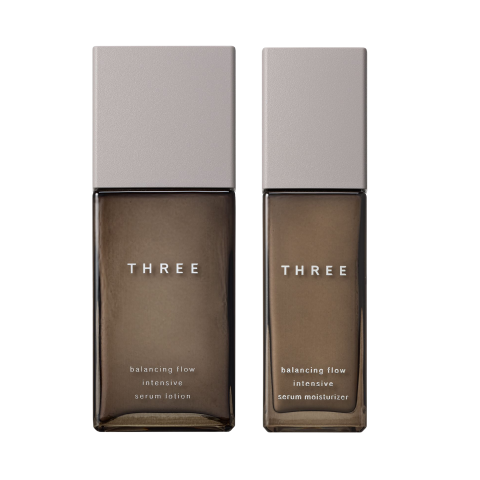
The richer half of Balancing Flow consists of just two products:
Balancing Flow Intensive Serum Lotion
and
Balancing Flow Intensive Serum Moisturizer.
THREE describes both as being born from serum technology rather than as conventional lotion and emulsion formulas.
The target is skin where dryness no longer feels like simple dehydration.
It may also look less plump, less luminous or less resilient, with fine lines caused by dryness becoming more apparent.
Instead of adding another separate serum between lotion and moisturizer, THREE has essentially made the lotion and moisturizer themselves more serum-like.
The Intensive Serum Lotion Starts as a Milky Drop

The Balancing Flow Intensive Serum Lotion has an unusual texture.
VOCE describes it as a rich, milky drop that transforms into a watery lotion once spread over the skin.
That transformation reflects the formula underneath it.
THREE uses what it calls an emulsified penetrating hyaluronic-acid formula, combining nano-sized hydrolyzed hyaluronic acid with its original rosemary essential oil and other skincare ingredients. The intended destination of “penetration” here is the stratum corneum, not deeper skin structures.
Compared with THREE's previous product, the brand reports approximately:
413% higher water-retention capacity in the lotion formula
and
115% more moisturizing ingredients.
Those are company comparison figures, but they tell us what THREE prioritized in the renewal: this is not merely a more aromatic lotion.
It is substantially more hydration-focused.
The formula has also passed efficacy testing for making fine lines caused by dryness less noticeable.
The Moisturizer Does a Different Job

The Balancing Flow Intensive Serum Moisturizer doesn't simply repeat the lotion in a thicker texture.
Here, THREE switches from penetrating hyaluronic acid to a long-lasting form of hyaluronic acid, sodium acetylated hyaluronate, and builds the formula around a three-layer veil designed to hold skincare ingredients and moisture against the skin.
THREE reports approximately twice the moisturizing-ingredient content of its previous product, while the firmness of the moisturizing veil increased to about 147% of the previous formula.
That gives the pair a logical division of labour:
Lotion → get moisture into the stratum corneum
Moisturizer → keep moisture there and create a more resilient-feeling veil
Both use the same Minamiaso rosemary essential oil and share a herbal-floral aroma.
The skincare mechanism, however, changes from one step to the next.
Conditioning Is for Skin That Is Dry and Oily at the Same Time
The other half of Balancing Flow is more interesting for a completely different reason.
A lot of skincare still assumes that skin belongs to one category.
Dry skin needs moisture.
Oily skin needs less richness.
But plenty of skin behaves in both ways at once.
It feels rough or dehydrated while the T-zone becomes oily. Pores look more noticeable. The surface feels uneven, yet adding a heavy moisturizer doesn't necessarily solve the problem.
THREE created Balancing Flow Conditioning around precisely that contradiction:
乾燥とベタつき — dryness and oiliness.
This time, rosemary gives way to peppermint.
And hyaluronic-acid technology gives way to nano-capsules.
Why Is THREE Talking About the Size of a Pore?

The Balancing Flow Conditioning Lotion contains moisturizing capsules that THREE describes as approximately 1/1000 the size of a pore.
That number is not there to imply that skincare needs to physically “fill” a pore.
The problem THREE is trying to solve is water affinity.
According to the brand, the environment around oilier pore openings can repel watery skincare. The Conditioning Lotion therefore uses extremely small natural nano-capsules designed to disperse and deliver moisture quickly into the stratum corneum without simply being repelled by sebum.
VOCE picked up on exactly this technology in its September report on noteworthy 2026 autumn/winter skincare.
The magazine highlighted THREE alongside new technologies from SOFINA and ALBION, noting its use of ultra-fine capsules to deliver moisture even through areas around pores that tend to resist water.
That's a much more useful way to understand Conditioning than calling it “pore care.”
It isn't primarily trying to strip oil away.
It's trying to moisturize skin that can be surprisingly difficult to moisturize evenly.
Then the Nano-Capsule Changes Its Job

As with Intensive, the moisturizer is not simply a thicker copy of the lotion.
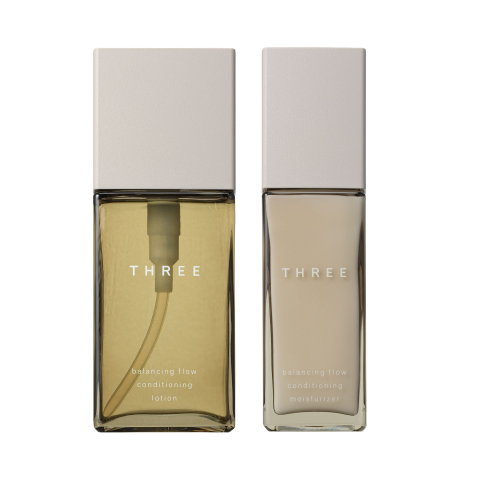
Balancing Flow Conditioning Moisturizer uses a sustained natural nano-capsule system combined with a high-water-retention veil.
The texture is a fresh gel milk that fits closely over the skin, with the aim of smoothing rough texture and making pores appear less noticeable through improved hydration and surface condition.
THREE says the roughness of the moisturizing veil was reduced by approximately 84% compared with its previous product.
Again, the pair has a simple logic:
Conditioning Lotion → deliver moisture quickly
Conditioning Moisturizer → maintain a flexible hydration veil
Both use peppermint essential oil, accompanied by bergamot in a clearer herbal-citrus scent.
Intensive vs Conditioning: The Difference Isn't Age
It would be easy to simplify the two lines into:
Intensive = older skin
Conditioning = younger skin
But that misses the formulation logic.
A better distinction is the current behaviour of the skin.
|
|
|
|
|---|---|---|
| Main concern | Dryness + loss of firmness | Dryness + oiliness |
| Also addresses | Dryness lines, dull-looking skin | Visible pores, roughness, uneven texture |
| Key essential oil | Minamiaso rosemary | Minamiaso peppermint |
| Delivery concept | Hyaluronic-acid system | Natural nano-capsule system |
| Lotion | Milky serum-lotion | Fresh, fast-absorbing lotion |
| Moisturizer | Rich serum milk | Lightweight gel milk |
| Aroma | Herbal floral | Herbal citrus |
| Natural-origin index | Lotion 98%; moisturizer 94% | Lotion 92%; moisturizer 95% |
The percentages are calculated according to ISO 16128 and include water.
The practical choice is therefore fairly straightforward.
If your skin increasingly feels dry, less plump and less firm, Intensive is the more relevant pair.
If your skin feels rough or dehydrated but still becomes oily or congested-looking, Conditioning makes more sense.
You Don't Necessarily Need to Use the Lines as Fixed Sets

There is another advantage to THREE keeping each system to a lotion and moisturizer.
The products are easy to understand individually.
Someone who wants the richer hydration of the Intensive Serum Lotion but doesn't enjoy a dense moisturizer may not necessarily need to approach Balancing Flow as an inseparable boxed routine.
Likewise, the Conditioning Lotion has a particularly clear role for combination-feeling skin even before considering the moisturizer.
The important distinction is what each technology is designed to do.
Intensive works around hyaluronic acid, moisture retention and firmness.
Conditioning works around nano-scale hydration, surface texture and the coexistence of dryness and sebum.
That is more useful than choosing by age bracket alone.
Japanese Beauty Media Is Paying Attention to the Technology, Not Just the Aroma
That's notable for THREE.
MAQUIA introduced Balancing Flow as a new essential-oil-science skincare range, but its product coverage focuses heavily on the physical formulas: the serum-like richness of Intensive and the nano-capsule/high-moisture veil structure of Conditioning.
VOCE goes further.
Its product pages describe the Intensive Serum Lotion's transition from a dense milky drop into a watery lotion and the Conditioning Lotion's pore-scale capsule design. In its wider Autumn/Winter 2026 skincare report, the magazine selected Conditioning Lotion as an example of how new Japanese skincare is paying renewed attention to the stratum corneum and the problem of getting hydration where it needs to go.
美的, meanwhile, focuses on the evolution of THREE's essential-oil research itself, describing Balancing Flow as a collection bringing together the brand's accumulated essential-oil science and separating Conditioning around the dual problem of dryness and oiliness.
The common thread is revealing.
The story isn't simply that THREE made four products that smell good.
The Japanese coverage is interested in how those aromatic ingredients now sit inside much more deliberate delivery and hydration systems.
Quick Questions About THREE Balancing Flow
When did THREE Balancing Flow launch?
The new collection launched throughout Japan on September 4, 2026.
What is the difference between Balancing Flow Intensive and Conditioning?
Intensive focuses on dryness, firmness, radiance and dryness-related fine lines using rosemary essential oil and hyaluronic-acid technologies. Conditioning targets the coexistence of dryness and oiliness, along with visible pores, roughness and uneven texture, using peppermint essential oil and natural nano-capsule technology.
Is THREE Balancing Flow natural skincare?
THREE reports natural-origin indices under ISO 16128, including water, ranging from 92% to 98% across the four Balancing Flow products. That describes ingredient origin under the standard; it should not be interpreted as a measure of efficacy or suitability for every skin type.
Which THREE Balancing Flow line is better for combination skin?
Conditioning is specifically formulated around dryness occurring alongside excess sebum, with additional focus on roughness, visible pores and uneven texture.
Which is better for dry, mature-feeling skin?
Intensive is the richer option and is positioned for dryness, reduced firmness, dull-looking skin and fine lines caused by dryness. Its Serum Lotion has also undergone efficacy testing for making dryness-related fine lines less noticeable.